Stephen Hawking’s black-hole information problem is one of the most famous puzzles in modern physics. If a black hole evaporates, what happens to the information that fell in? The modern answer is usually not “the information is destroyed,” but “the information gets scrambled.” It is still in the quantum state, but spread out so broadly that local recovery becomes extremely hard.
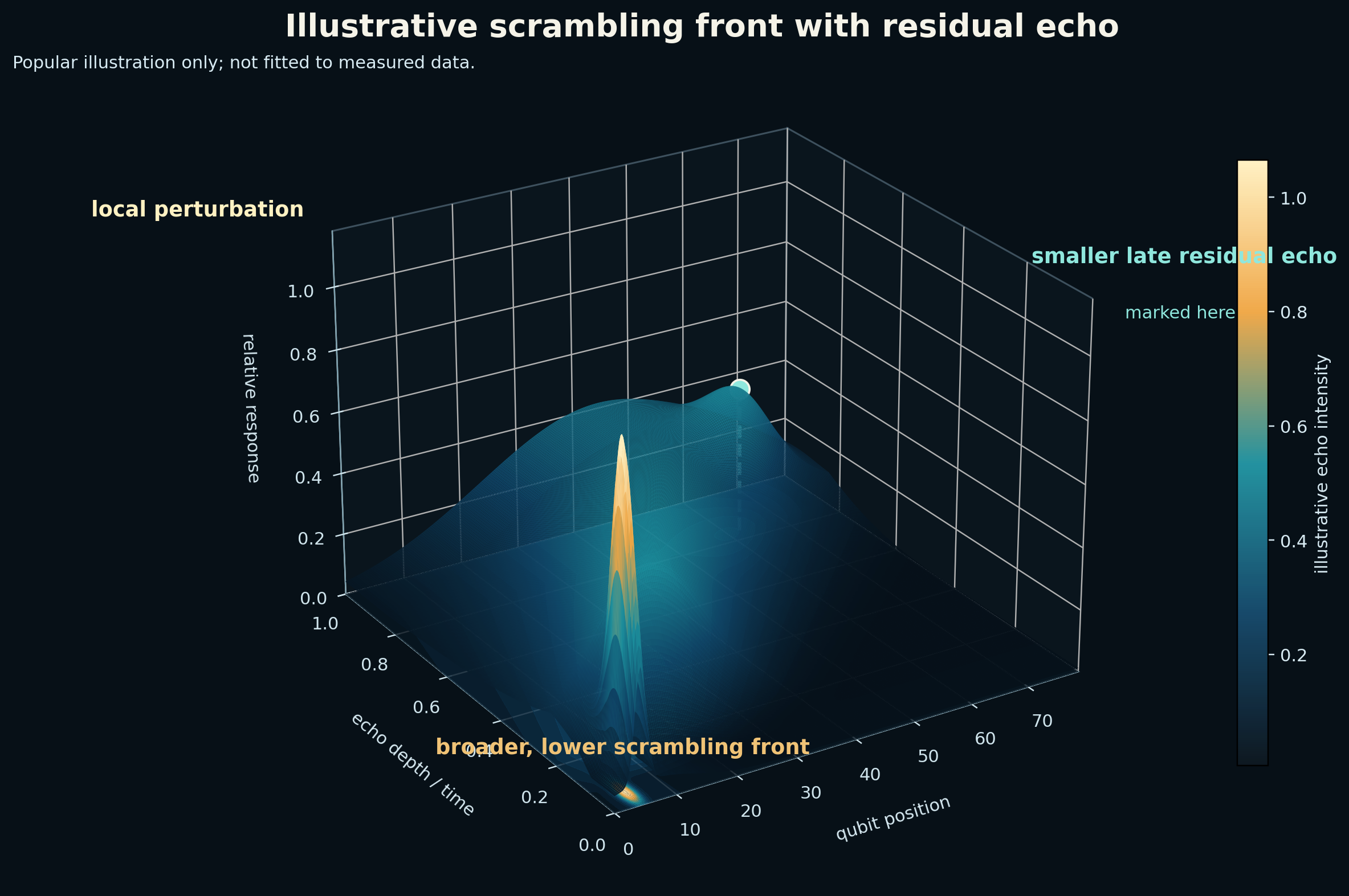
That is where OLE, or the operator Loschmidt echo, becomes interesting. In simple terms, OLE asks how strongly a local disturbance is still visible after a system evolves, scrambles, and is probed again. If the disturbance stays local, recovery is easier. If it spreads across the whole system, the signal changes in a structured way. That is the same broad information-flow logic that makes black holes so interesting in quantum theory.
Strictly speaking, this repo is a staged bridge toward OLE, not yet a claim that a final fixed-observable 80-qubit OLE estimator has already been implemented. That distinction is important, and it is part of what makes the write-up credible.
What this project actually studies
This repository does not claim to simulate a real astrophysical black hole. It studies a hardware-accessible echo benchmark inspired by the same scrambling story. The practical question is:
If we perturb one qubit locally and run an echo-style circuit, does the response stay local, or does it spread across the device in a structured way?
The current evidence ladder runs across q14, q20, q24, q32, and q80. The most important result is that a locality-sensitive signal survives all the way to an 80-qubit pilot.
The clearest hardware result
The repo reports a staged set of measurements. The strongest large-system evidence is still subset-proxy evidence rather than a final full-register OLE closure. That distinction matters.
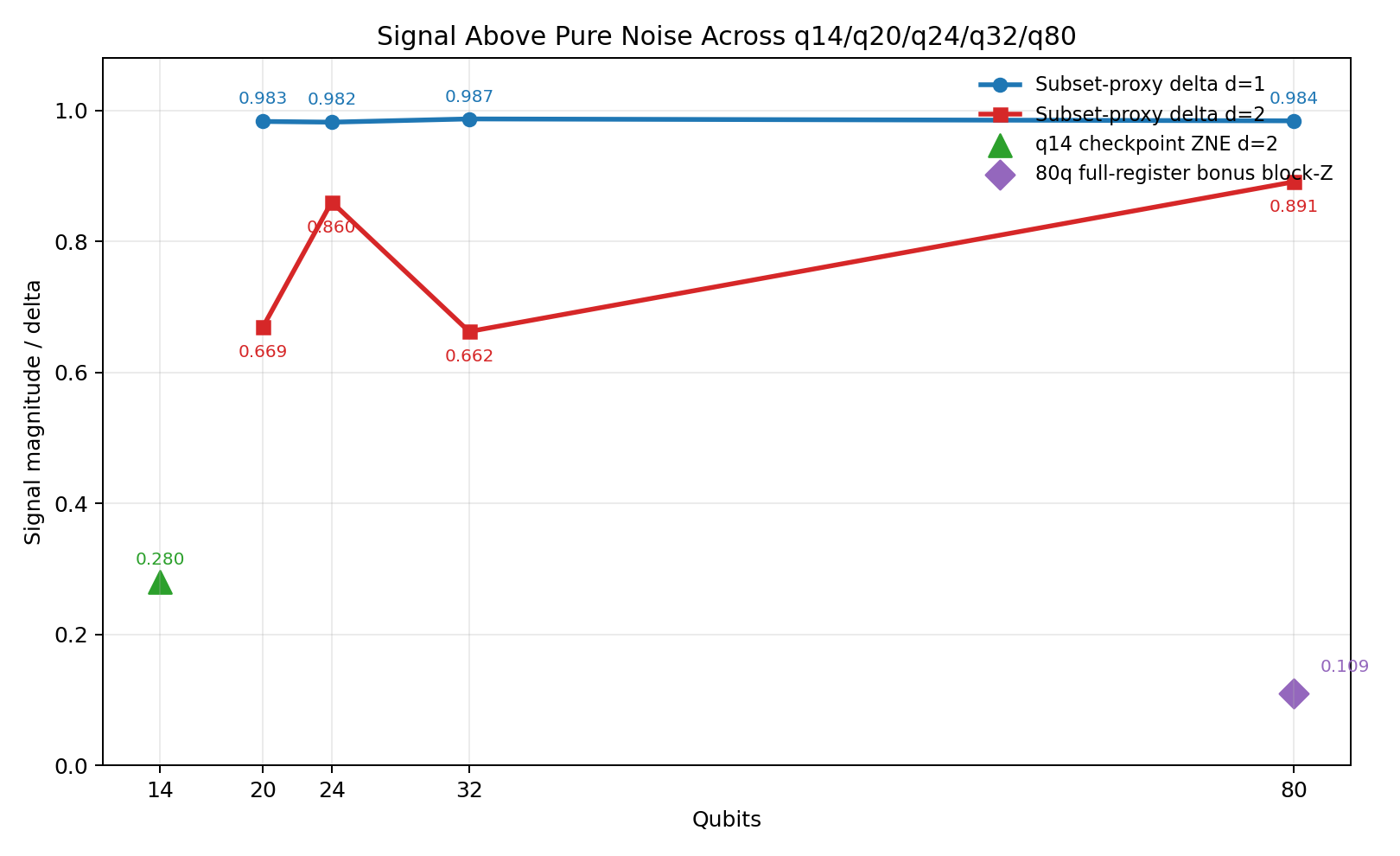
- At q14, the strongest checkpoint-level anchor is a corrected local-fold ZNE signal of 0.27957 at depth 2.
- At q20, q24, q32, and q80, the readout-mitigated subset-proxy locality signal remains strongly positive.
- For the first q80 subset pilot on
S_A = 0..9, comparing an overlap perturbation atq=0against a far-disjoint perturbation atq=79, the contrast is +0.98420 at depth 1 and +0.89110 at depth 2. - An exploratory, harder full-register bonus analysis based on a mirrored block-Z observable still remains positive at 0.10932.
Those numbers matter because they show that the signal does not vanish into pure noise when the system gets larger. The structured response remains visible even at 80 qubits.
Why this connects to the black-hole information story
The link is conceptual and physical, not literal astronomy.
- Information starts locally.
- Under scrambling dynamics, that information spreads across many degrees of freedom.
- Local recovery becomes harder.
- The information is not simply erased; it becomes harder to read out locally.
That is the same basic logic behind the black-hole information problem. In that sense, these echo-style hardware experiments are probing a real many-body scrambling story, even though they are not black holes in the astrophysical sense.
What is claimed, and what is not
Supported now:
- Strong subset-level locality evidence from q20 through q80.
- A successful 80-qubit subset pilot.
- A smaller but still structured 80-qubit full-register bonus signal.
Not supported yet:
- A literal black-hole experiment.
- Full 80-qubit fixed-observable OLE closure.
- A claim that the current observable family already proves global q80 hardware confirmation.
That claim discipline is one of the strongest parts of the repo. It is ambitious without pretending that the last step has already been completed.
Why this matters
A lot of quantum-computing coverage focuses on speed, hype, or broad advantage language. This project is interesting for a different reason. It treats present-day hardware as a tool for studying information flow, locality, and scrambling in many-body systems. That is a more physics-driven way to use a quantum device.
If this staged path keeps holding up, it could become the basis for a much stronger future paper on OLE-style diagnostics, subsystem echoes, and the black-hole information story on actual hardware.
Repository and further reading
- Repository: github.com/BramDo/onderzoek_blackhole_echo_status_2026-03-05_131816
- Hayden and Preskill, Black Holes as Mirrors: Quantum Information in Random Subsystems (2007)
- Sekino and Susskind, Fast Scramblers (2008)
- Yan, Cincio, and Zurek, Information Scrambling and Loschmidt Echo (2020)
- Mi et al., Information Scrambling in Quantum Circuits (2021)
Short version: this repo does not show a real black hole in the lab, but it does show something scientifically meaningful: a locality-sensitive echo signal that stays visible from q14 up to an 80-qubit pilot, with a careful bridge toward the operator Loschmidt echo story behind black-hole information scrambling.
