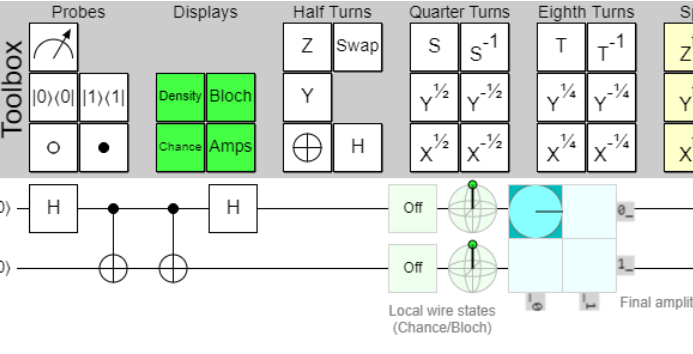

The logical OLE circuit is only the beginning. A circuit with 1,056 logical CZ gates must still be mapped onto a real chip with imperfect gates, finite coherence, calibration variation, and readout error.
For this run, the target was ibm_kingston, a 156-qubit IBM processor. The 80 active logical qubits were selected as a connected heavy-hex subgraph containing the released 70-qubit tracker graph.
Why topology matters
A two-qubit gate can be executed directly only when the selected physical qubits are connected in the hardware coupling graph. Poor placement introduces routing overhead, usually through additional swap-like operations. That increases depth and exposes the state to more noise.
The Q80 extension therefore did not add ten arbitrary qubits. It added the complete first frontier around the released graph and selected the remaining frontier sites to stay spatially distributed. The resulting graph has 88 edges that can still be divided into the same three non-overlapping scheduling layers.
What Fire Opal did
The 16 OpenQASM circuits were submitted through Fire Opal's execute path. Fire Opal applies an automated error-suppression pipeline and returns post-processed results. Q-CTRL documents that its hardware workflow includes circuit optimization and measurement-error mitigation; retrieving only the provider result would omit that Fire Opal post-processing.
For this experiment, the representative compiled summaries were:
- Perturbed circuit: depth 105 and 674 two-qubit gates
- Delta-zero control: depth 88 and 574 two-qubit gates
- Shots: 8,000 per circuit
- Total circuits: 16
The logical perturbed and control circuits each contained 1,056 CZ operations. The different compiled counts show that the compiler did real circuit simplification and hardware adaptation. They also warn us that the ratio is not a perfect experiment in which only delta changes and every physical pulse remains identical.
Readout mitigation without overclaiming
The raw hardware returns 80-bit outcomes. Fire Opal's measurement-error mitigation improves the returned distributions using additional calibration-style information.
That does not mean we reconstructed and inverted a dense 2^80 by 2^80 response matrix. Such a matrix would itself be astronomically large. The OLE analysis computes the parity expectation of the three measured observable bits from the mitigated full-register distribution.
This distinction matters. The project has all-qubit measurement coverage, but the scientific output is a selected low-weight observable. It is not full-state readout.
Runtime evidence
The Fire Opal action was created at 19:37:13 UTC and updated as successful at 19:42:41 UTC, an end-to-end interval of 328 seconds. The underlying IBM job took 155.23 seconds from creation to completion. IBM reported 43.85 estimated QPU seconds and 53 billed quantum seconds.
Those are several different clocks:
- QPU time counts the quantum processor usage estimate.
- Provider job wall time includes provider-side handling.
- Fire Opal action wall time includes the wider managed workflow.
A fair classical comparison must state which clock it uses. The next article does that with a tracker-linked belief-propagation tensor-network calculation.