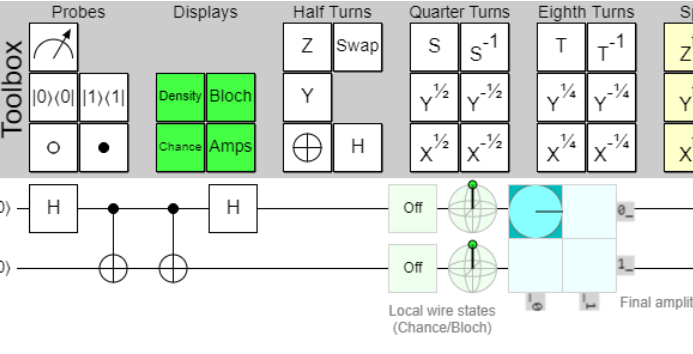

The Operator Loschmidt Echo (OLE) was one of the observable-estimation examples discussed by Minh Tran in Quantum Algorithms III at the Qiskit Global Summer School 2026. The lecture provides an unusually direct external reference point for this Black Hole OLE project: it uses the same forward evolution, local perturbation, inverse evolution, and fixed-observable readout that define the project’s exact OLE route.
The OLE protocol shown at QGSS26
Slide 16 of the lecture presents the experiment as an observable-estimation circuit:
prepare ρ ∝ O → U → Vδ → U† → measure O
Here U scrambles an initially local observable, Vδ introduces a controlled perturbation, and U† attempts to reverse the dynamics. In the small-perturbation regime, the lecture summarizes the signal as
\mathrm{signal}\approx 1-\frac{\delta^2}{2}\,\mathrm{OTOC}.
\]
This is why OLE can probe operator spreading. As the evolved observable spreads over more qubits, it becomes sensitive to perturbations at more locations. The initial quadratic loss of the echo therefore exposes the same non-commutation structure that appears in an out-of-time-order correlator.
The 56-qubit summer-school example
The lecture then applies this logic to Floquet-Ising dynamics designed to scramble operators on a 56-qubit patch of ibm_boston. The deepest displayed circuit has depth 72 and 1,488 CZ gates. Its experimental signal is treated with heuristic global rescaling and compared with tensor-network belief propagation (TN-BP).
At the deepest circuit, the rescaled TN-BP answer and the mitigated quantum result disagree. Instead of declaring one answer correct from a single comparison, the lecture builds a case from several pieces of evidence:
- At depth 36, the mitigated hardware signal agrees with a converged TN-BP calculation.
- At depth 72, the mitigated signal is reproducible under different experimental error profiles.
- The deep result lies inside a theoretically predicted region.
The conclusion is deliberately restrained: the hardware result can be trusted more than the available TN-BP estimate, but the lecture explicitly labels it not yet quantum advantage. Other classical heuristics still need to be benchmarked, and the deepest answer is more trustworthy without becoming exactly verifiable.
Where this project is directly compatible
The closest match inside the Black Hole OLE repository is the exact fixed-observable implementation in qiskit_black_hole_ole_exact.py. It evaluates
F_\delta(P)=2^{-n}\operatorname{Tr}\!\left(A_P(U)V_\delta^\dagger A_P(U)V_\delta\right),
\qquad
A_P(U)=UPU^\dagger .
\]
The locked q14 configuration uses P = Z_0. It compares an overlapping perturbation generator, G = X_0, with the far-disjoint control G = X_10. This is not merely an echo-shaped circuit: it implements the same fixed-observable operator ordering used in the QGSS26 example.
The repository also makes the small-δ bridge explicit:
\[F_\delta(P)
=1-\frac{\delta^2}{2}\kappa_G(P;U)+O(\delta^4),
\] \[
\kappa_G(P;U)
=2^{-n}\operatorname{Tr}\!\left([G,A_P(U)][G,A_P(U)]^\dagger\right).
\]
The commutator norm κ is the precise operator-growth quantity behind the lecture’s compact “OTOC” label. The code obtains it from the propagated Pauli expansion, so the implementation exposes not only the final echo curve but also the operator weight responsible for its decay.
What “compatible” does and does not mean
| Feature | QGSS26 lecture | Black Hole OLE project |
|---|---|---|
| Core sequence | O, U, V_delta, U-dagger, O |
Same fixed-observable ordering in the exact q14 route |
| Physical interpretation | OLE as a probe of OTOC/operator spreading | Small-delta commutator norm and Pauli-support growth |
| Large experiment | 56 qubits on ibm_boston, depth 72 |
Separate q20-q80 hardware evidence ladder |
| Error treatment | Heuristic global rescaling | Readout mitigation, locality controls, ZNE, and exploratory alternatives |
| Claim boundary | No demonstrated quantum advantage | No full-q80 fixed-observable OLE closure or general advantage claim |
The distinction in the final row matters. The repository’s perturbed_echo baseline is a state-return probability, while its q20-q80 subset and block-Z measurements are support-sensitive proxies. Those results belong to the same operator-spreading evidence ladder, but they must not be renamed as direct fixed-observable OLE measurements. The direct protocol compatibility applies most cleanly to the separate q14 exact OLE implementation.
Why this strengthens the project
The summer-school treatment independently confirms three design choices already present in this project:
- OLE is an experimentally accessible route to operator spreading and OTOC-like information.
- Deep quantum results need a portfolio of validation evidence rather than one classical comparison.
- Classical difficulty and a plausible mitigated signal do not, by themselves, establish quantum advantage.
That makes the relationship meaningful without overstating it. QGSS26 discussed the same scientific protocol family; the Black Hole OLE project contains a mathematically compatible implementation and extends the idea with explicit locality controls, an exact q14 operator calculation, and a staged path toward larger hardware experiments.
Sources and project links
- Minh Tran, Quantum Algorithms III, Qiskit Global Summer School 2026, especially slides 16-31.
- Official QGSS2026 exercise repository.
- Black Hole OLE project and article series.
- Public Black Hole OLE repository.
- Part 2: how an Operator Loschmidt Echo works.