Part 2 of the Floquet-Ising series: from two qubits to prethermal oscillations
The abstract Floquet unitary from part 1 becomes a concrete quantum circuit in the paper. Each cycle contains uniform rotations of all spins and interactions between neighbouring spins. The order is essential: an X rotation, a Z rotation, and a ZZ coupling do not generally commute.
Three ingredients
For N spins, we define the collective operators
\[X_\Sigma=\sum_{q=1}^{N}X_q,
\qquad
Z_\Sigma=\sum_{q=1}^{N}Z_q.
\]
The heavy-hexagonal connections are coloured into three sets E1, E2, and E3. Within one colour, no pair of bonds shares a qubit. All ZZ gates of that colour can therefore be executed in parallel. For colour r, we write
\[C_r=\sum_{\langle i,j\rangle\in E_r} Z_iZ_j.
\]
The Floquet unitary is then
\[U_F=\prod_{r=1}^{3}
\left(
e^{-i\theta_{zz}C_r/2}
e^{-i\theta_z Z_\Sigma/2}
e^{-i\theta_x X_\Sigma/2}
\right).
\]
Because operator products act on the state from right to left, each colour layer first receives an X-field rotation, then a Z-field rotation, and finally the corresponding ZZ bond layer.
What do the gates do physically?
An RX rotation mixes the Z-basis states |0> and |1>. It creates superpositions and changes the local magnetization. An RZ rotation changes relative phases. Measured by itself in the Z basis, such a phase seems invisible, but after later noncommuting gates it affects interference.
The RZZ gate is
\[R_{ZZ}(\theta_{zz})=
e^{-i\theta_{zz}Z\otimes Z/2}.
\]
This gate is diagonal in the Z basis, but gives the even-parity states |00> and |11> a different phase from |01> and |10>. Combined with the X rotations, it builds entanglement.
Why heavy-hex?
Heavy-hex is the connectivity graph of several IBM processors. Each qubit has relatively few neighbours, which helps limit crosstalk and fabrication problems. In this experiment, the graph is also the physical lattice: the hardware connections are the Ising bonds.
The three edge-colour layers are not a cosmetic compiler trick. They determine the digital time ordering of the interactions. Gates within one colour can run in parallel; field rotations are applied again between colours. The circuit depth therefore grows linearly with the number of Floquet cycles, rather than with the total number of bonds per cycle.
The selected parameter point
Using exact 21-qubit scans, the paper finds a compromise between preserved magnetization and accumulated complexity. The selected total field angles are approximately
\[3\theta_x\approx1.57,
\qquad
3\theta_z\approx0.34,
\qquad
\theta_{zz}\approx1.05.
\]
Per layer, this means approximately theta-x = pi/6, theta-z = pi/27, and theta-zz = pi/3. The public 51-qubit QASM contains slightly more precise per-layer values: 0.5218893141 and 0.1129311682 radians. Our original toy model uses the simple pi fractions; a separate tracker reference uses the QASM values exactly.
Initial state and observables
The initial state is fully ferromagnetic:
\[|\psi_0\rangle=|0\rangle^{\otimes N}.
\]
The paper mainly tracks average magnetization
\[M=\frac{1}{N}\sum_{q=1}^{N}\langle Z_q\rangle.
\]
The public 51-qubit tracker additionally uses the average of 86 ZZ correlations at graph distance three. This is a different observable from the two-qubit magnetization. Two numbers may only be compared when the system, cycles, parameters, and observable are the same.
The reduction to two qubits
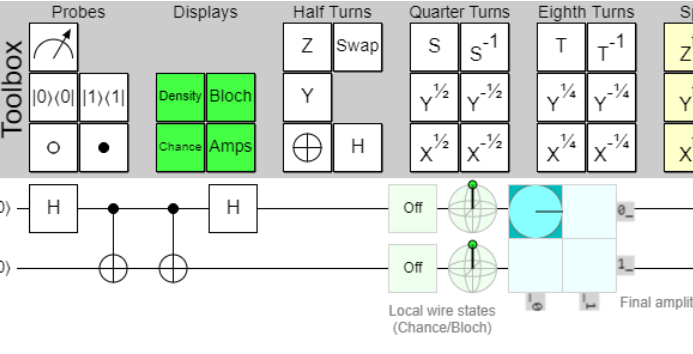
With two spins, there is only one bond. We place it in colour layer 1; the other two colour layers still contain their X and Z rotations, but no ZZ gate. In time order:
RX x RX
RZ x RZ
RZZ
RX x RX
RZ x RZ
RX x RX
RZ x RZ
This reduction preserves the gate convention, three layers, repetition, and interplay of fields and interaction. It removes almost everything that makes the large problem genuinely difficult: the heavy-hex geometry, spatial operator growth, 86 correlation pairs, and a thermodynamic scaling analysis.
An important conceptual boundary
A circuit can use the same local gates and still display different collective physics. Many-body properties arise not only from the gate type, but from the combination of geometry, system size, initial state, and time. We therefore call the two-qubit version a mechanism check, not a scaled-down experimental reproduction.
In part 3, we calculate these seven gates explicitly. We start from |00>, construct the four-by-four Floquet matrix, and check the first magnetization directly from the four measurement probabilities.
Sources
- E. Leviatan et al., paper and equation (1).
- Exact mapping to the public 51-qubit QASM.