Public research series · August 2026
Why is gold yellow, what role does relativity play, and what can a quantum computer genuinely add? This series follows one auditable route from measured gold optics and relativistic band structure to Qiskit circuits on 4 and 24 qubits.
What has already been achieved
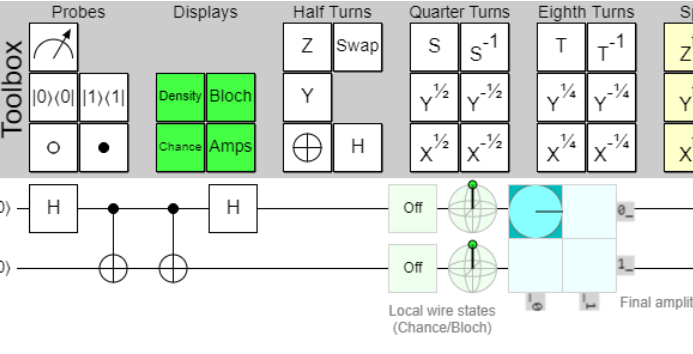
An accepted QE+SOC/Wannier90 Hamiltonian with 12 spinor modes and 11 electrons reduces exactly to a 12-dimensional one-hole space.
Measured on IBM Kingston after M3 readout correction and exact postselection onto the allowed compact space. This is a hardware smoke test, not a prediction of gold’s colour.
All 24 spinor modes come from the QE+SOC/Wannier90 chain. The occupied-band state evolved on IBM Kingston without VQE.
The evidence map
| Layer | Status | What the evidence supports | What it does not yet support |
|---|---|---|---|
| Measured optics | Reference | Olmon data combined with CIE colour conversion reproduce the known reflectance edge and gold-like colour. | This is not a prediction from the quantum circuit. |
| QE+SOC → Wannier90 | Validated for the compact one-particle route | The 12 spinor modes are material-derived and checked on the relevant grid. | No complete interacting Brillouin-zone optical calculation yet. |
| 4-qubit IBM | Executed | Real QPU execution of the exact one-hole reduction, including noise analysis. | No many-body or quantum advantage claim. |
| 24-qubit gold | Material-derived and executed on hardware | A frozen charge response of 24 genuine spinor modes was exactly validated, routed and measured with 24 physical qubits. | The PEA improvement is not statistically significant and does not reconstruct the full electronic state. |
| 48–72 qubits | Research roadmap | The active-space ladder and acceptance tests are explicit. | No hardware or advantage result. |
Why this series exists
A 2025 paper attempted to combine DFT and VQE for metal clusters. The aluminium calculations succeeded, but the gold route encountered memory limits, open-shell handling and missing relativistic support. That negative result matters because it identifies a formulation that asks too much at once.
Our route begins with a narrower question. If the initial state and Hamiltonian are known and the goal is real-time evolution, a VQE minimum does not need to be found. Symmetry and particle number can sometimes compress the relevant Hilbert space exactly. For the 24-qubit step we also restrict the claim itself: one local observable at one short time.
Reading order
The nine parts progress from physics to hardware and finish with the forced 56-qubit experiment on IBM Marrakesh, including what mitigation can and cannot say about the electrons. Every part includes its sources and claim boundary.
Sources and reproducibility
- Pollard, Hines & Clayborne (2025), Exploring Quantum Computing for Metal Cluster Analysis
- Pyykkö & Desclaux (1979), relativistic effects in chemistry
- Christensen & Seraphin (1971), band structure and optical properties of gold
- Olmon et al. (2012), measured optical constants of gold
- Quantum ESPRESSO methodology
- Wannier90 methodology
- IBM Qiskit: PauliEvolutionGate
Project status: 13 August 2026. Numerical values come from the frozen local research artifacts; the original claim boundaries are deliberately preserved.