Floquet-Ising: theory and a fully reproducible toy model
How can a periodically driven quantum system display orderly oscillations for a long time while interactions simultaneously build entanglement and complexity? This six-part series makes the theory behind a prethermal Floquet-Ising magnet visible step by step.
The central paper by Leviatan et al. studies large periodically driven spin lattices of up to 74 qubits. This series deliberately starts much smaller. With two qubits, we can calculate every gate, amplitude, probability, magnetization, and entropy exactly. This toy model is not a miniature version that automatically possesses the same many-body phase. It is a transparent laboratory for the mechanism and the computational methods.
The connecting thread
periodic driving
    -> Floquet unitary U_F
    -> repeated quantum dynamics
    -> magnetization and entanglement
    -> noise and error mitigation
    -> classical scaling limits
    -> a precisely defined quantum-advantage question
The articles strictly separate three levels: exact statements about the two-qubit model, numerical evidence from larger classical patches, and experimental results from the 51- and 74-qubit circuits. This lets us explain the interesting physics without promoting an educational calculation into evidence of quantum advantage.
The series
1. Floquet physics: order in a periodically driven system
What is a Floquet unitary, why does a generic system heat up, and how can a long prethermal time window emerge?
2. The Floquet-Ising cycle on a heavy-hex lattice
We break down the X and Z fields, the ZZ interactions, and the three edge-colour layers of a complete cycle.
3. The two-qubit toy model worked out in full
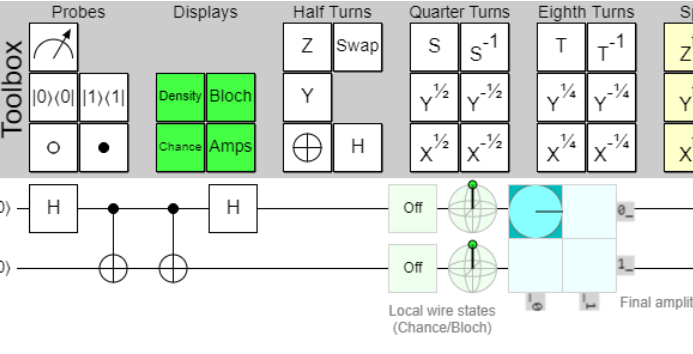
From the state |00>, through seven gates, to four amplitudes, measurement probabilities, and the first exact magnetization value.
4. Magnetization, entanglement, and the period-four oscillation
Why are a local order parameter and entanglement entropy complementary, and what is required to demonstrate a genuine subharmonic oscillation?
5. Noise and error mitigation without magic
We derive the toy ZNE formula, compare it with PEC, and explain why a nearly perfect toy correction proves nothing about real hardware.
6. From toy model to 51 qubits: where does quantum advantage begin?
The validation ladder from 2 to 21 and 51 qubits, the MPS convergence limit, and the criteria for a fair quantum-advantage claim.
What you can reproduce yourself
The open repository contains the NumPy calculation, an independent Qiskit check, a notebook, regression tests, figures, and progressively larger heavy-hex patches. The standard toy model runs entirely classically and requires no IBM account.
Scientific boundary
The toy model demonstrates unitary Floquet behaviour, oscillations, entanglement, and mitigation arithmetic. Two qubits, however, do not form a thermodynamic system and cannot demonstrate the paper’s many-body prethermalization. The larger results in the repository form a reproducible validation ladder; the quantum-advantage question still depends on using the same observable and accuracy, establishing classical convergence, and making a fair resource comparison.