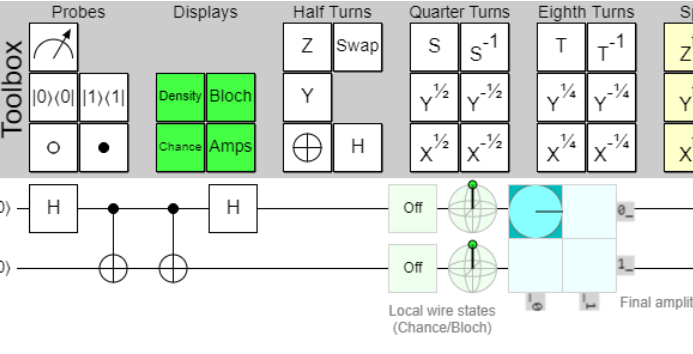

A 61-qubit random-circuit experiment on IBM Nighthawk r2, repeated alongside a local classical MPS comparison. This series shows the measured values while keeping runtime, sample quality and the quantum-advantage claim distinct.
What happened?
In the preprint by Sedrakyan and colleagues, a random circuit on 61 qubits with 36 cycles and 918 CZ gates was sampled on ibm_phoenix. The researchers reported one million bitstrings in 19 seconds of QPU time. They estimated deep-circuit fidelity near 0.0023 using separate mirror and patch experiments.
We ran the same released logical circuit on the same backend and physical layout: another million bitstrings and another 19 seconds of reported QPU time. Our full-width bitstrings were not directly scored against ideal amplitudes. We repeated the timing, not the paper’s fidelity estimate.
Read the series
- Part 1 — The paper and its method
- Part 2 — Our 61-qubit measurements
- Part 3 — MPS and the limits of the comparison
- Part 4 — RCS theory and applications
Three numbers to start with
| Route | Samples | Reported time |
|---|---|---|
| Paper: quantum | 1,000,000 | 19 s QPU |
| Our IBM run: quantum | 1,000,000 | 19 s QPU |
| Our MPS, χ=128 | 1,000 | 1,249 s local runtime |
The latter two timings show a large lead over this tested MPS implementation. They use different clocks, and the MPS output still differs from IBM on simple bit statistics. We therefore make no new claim that our run beats the best classical method at matched output quality.
Project overview and article source
Edukaizen · 25 september 2026 / 25 September 2026