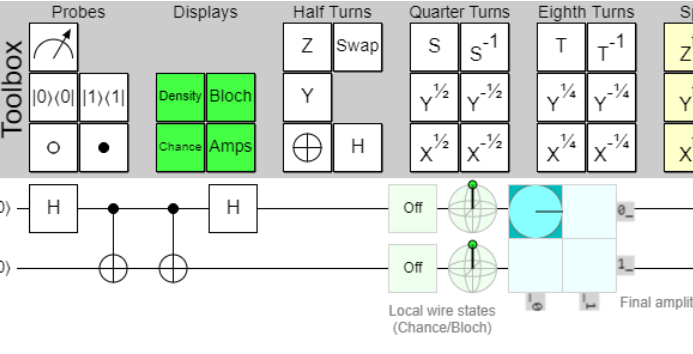

Fibonacci anyons are among the cleanest examples of non-Abelian quantum statistics: changing the order of two braids can change a measurable probability. This project reconstructs that mathematics, embeds it in small quantum circuits, and asks how much of the signal survives a real superconducting processor.
Claim boundary: the IBM processor digitally encodes Fibonacci-anyon mathematics in ordinary qubits. It does not create physical Fibonacci anyons, does not make the qubits topologically protected, and does not demonstrate quantum advantage.
The project in one question
Can we start from the exact Fibonacci fusion rules, reproduce the published three-, five-, and nine-qubit circuits, and obtain a controlled hardware measurement of a genuinely order-sensitive braid observable without overstating what the experiment means?
The answer is now nuanced. The algebra and ideal circuits close to numerical precision. The literal full nine-qubit source circuit is far too deep after hardware decomposition. A much shallower, fixed-input observable does run cleanly enough for a controlled IBM diagnostic, but that compressed experiment no longer executes every F-move drawn in the source circuit.
Current evidence
| Layer | Result | Present verdict |
|---|---|---|
| Fibonacci category | Pentagon, hexagon, unitarity, and braid relations pass | Exact algebra validated |
| Minimal circuit ladder | 3q fusion, 5q twist, and corrected 9q braid reproduce their targets | Ideal digital circuits validated |
| Full 9q hardware route | Generic compilation reaches thousands of two-qubit gates | Revise circuit or observable |
| Structure-aware synthesis | Full order arms reduced to 161 CX gates and depth 285 | Major improvement, still not ready |
| Fixed-input observable | 0 CX gates; only the logical qubit carries coherent F/R dynamics | Suitable for a narrow diagnostic |
| IBM diagnostic | Corrected \(P_0=0.3917\) with 95% interval \([0.3490,0.4353]\); ideal \(1/\phi^2=0.3820\) | Proceed to a higher-shot repeat |
| Quantum advantage | No scaling separation or classically hard end-to-end task has been shown | Not established |
The six-part series
- Fusion, F-moves, R-moves, and non-Abelian braiding develops the two-dimensional fusion space and the order-sensitive observable.
- The three-, five-, and nine-qubit validation ladder reconstructs the minimal circuits and explains the fixed-register corrections.
- Why the full nine-qubit circuit was too deep separates statistical detectability from physical interpretability and audits mitigation.
- Structure-aware simplification of the Fibonacci F-move follows the route from thousands of entangling gates to a zero-CX logical observable.
- An interleaved IBM Marrakesh hardware diagnostic reports the controls, drift checks, leakage, and corrected probability from the real device.
- What the experiment establishes — and what remains open gives a claim-by-claim evidence table and the next research gates.
Why the distinction between “full circuit” and “fixed observable” matters
A quantum circuit can be simplified in two very different senses. A source-equivalent synthesis implements the same operation on every state in the relevant source support. An observable compression only preserves a preregistered output for one fixed input. Both are scientifically useful, but they support different claims.
This project keeps those two routes separate. The full nine-qubit reconstruction is the stronger representation of the published protocol, yet it is too deep for a defensible hardware run. The compressed hardware experiment is extremely shallow and experimentally interpretable, yet it validates only one fusion-space observable. The website, repository, and reports retain that distinction throughout.
Primary sources and reproducibility
The circuit ladder follows Bseiso et al., Minimal Quantum Circuits for Simulating Fibonacci Anyons. The broader string-net and chromatic-polynomial direction is represented by Minev et al., Realizing string-net condensation. Code, notebooks, frozen conventions, machine-readable outputs, and verification reports are available in the public project repository.