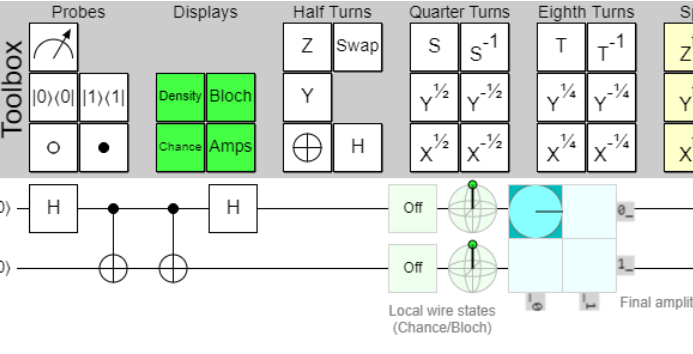

The key simplification comes from treating F as a very special matrix instead of an arbitrary one-qubit unitary. With \(\cos\theta=1/\phi\), it factors exactly as
\[F = R_y(2\theta)Z = R_y(\theta) Z R_y(-\theta).
\]
Only the central Z needs the full control predicate. The surrounding rotations can often be moved, shared, or cancelled. This turns algebraic knowledge into a circuit-resource reduction.
Every simplification in the source-equivalent route is checked on the complete computational-basis support reachable from the fixed preparation. Equality is not claimed for arbitrary unreachable nine-qubit inputs, and the resource reduction is not quantum advantage.
First reduction: exploit reachable controls
The generic four-controlled F required about 218 CX gates. Factoring F and controlling only its central Z reduced that block to 44 CX gates. An audit of the actual source trajectory then showed that six of the nine primary-route F predicates needed only three effective controls. Two verified clean qubits could be borrowed as work qubits and returned to their original state.
The resulting resource change was large:
| Circuit | Generic CX/depth | Reachable-support CX/depth |
|---|---|---|
| Primary filter, all-to-all | 2,158 / 8,319 | 292 / 626 |
| Order arm, all-to-all | 1,476 / 5,692 | 220 / 510 |
| Primary filter, heavy-hex proxy | 4,300 / 10,009 | 755 / 1,050 |
| Order arm, heavy-hex proxy | 2,926 / 6,854 | 561 / 827 |
The mild one-qubit noise point now passed the leakage gate. Mild two-qubit leakage fell from 61% to 11.7%, narrowly missing the 10% threshold. Thermal and combined points still failed.
Second reduction: cancellations and a multiplexer
The source action of a full F block can be written as a classical relabelling predicate followed by a controlled F action. Once those roles were separated, two further identities became visible.
First, the last F block in the initialization and the first F block in the primary exchange were identical adjacent involutions, so they cancelled exactly. Second, two separate readout branches could be replaced by one two-control multiplexer because a third control was redundant everywhere on the reachable support.
This reduced the primary circuit from 292 to 189 CX gates and from depth 626 to 332. Each order arm fell from 220 to 161 CX gates and from depth 510 to 285. All six checked end states still agreed with the generic source circuit within \(10^{-10}\).
The repeated noise gate improved again. Mild one- and two-qubit proxies now passed with leakage 1.24% and 7.74%. Thermal and combined leakage remained 38.9% and 44.3%, and neither reached the frozen power-and-interpretability gate within 131,072 shots. The full source-equivalent route therefore remained REVISE CIRCUIT OR OBSERVABLE.
Third reduction: preserve only the fixed observable
The decisive conceptual step was to ask what the experiment actually measures. For the frozen input, the order-sensitive information lives in one logical fusion-space qubit. The other eight qubits can be replaced by a fixed computational-basis guard while q2 carries the coherent F and R dynamics.
| Compressed circuit | 1q gates | CX | Depth |
|---|---|---|---|
| Order 12 | 5 | 0 | 2 |
| Order 21 | 9 | 0 | 6 |
| Primary control/filter | 6 | 0 | 2 |
All frozen mild noise points then passed the same raw power, leakage, and filter thresholds. This route is not another synthesis of the entire source operation. It is an observable compression: on this input it preserves the same final states and \(P(q_2=0)\) values, but it does not execute all source-drawn F-moves.
Two valid experiments with different meanings
The 161-CX order arm remains the best source-equivalent implementation developed here. It is the correct object for claims about reconstructing the nine-qubit process, but it is still too deep. The zero-CX arm is the correct object for a controlled test of one logical non-Abelian observable, but it cannot inherit the stronger full-circuit claim.
Keeping that distinction explicit is the central scientific safeguard of the simplification program.