Part 1 of the Floquet-Ising series: from two qubits to prethermal oscillations
A stone that receives the same push again and again usually responds predictably: every push adds energy. A periodically driven quantum system is subtler. The state interferes with earlier versions of itself, interactions spread local information, and relevant observables can develop a rhythm that is not simply the rhythm of the drive.
Floquet physics studies exactly such systems. The name comes from the mathematics of differential equations with periodic coefficients. In quantum mechanics, we summarize one complete period in a single unitary operation. If the drive period is T, we write
\[U_F = \mathcal{T}\exp\!\left[-i\int_0^T H(t)\,\mathrm{d}t\right],
\qquad H(t+T)=H(t).
\]
The time-ordering symbol T reminds us that Hamiltonians at different times do not always commute. After n cycles, the state is simply
\[|\psi_n\rangle = U_F^n |\psi_0\rangle.
\]
This looks like repeated matrix multiplication. Yet precisely this repetition can produce rich nonequilibrium physics.
Why a driven system eventually heats up
An isolated, generic many-body system can absorb energy from the periodic drive. Because there is no cold reservoir to remove that energy, local structure eventually fades. For many local observables, the late-time state then resembles an infinite-temperature state: not because the total quantum state has become classically random, but because small subsystems retain almost no useful memory of the initial order.
The magnetization of an initially ferromagnetic spin configuration, for example, may relax toward an almost structureless value. The microscopic evolution remains unitary and reversible, but the information is distributed across complex many-body correlations.
The prethermal intermediate regime
Heating need not happen immediately. Under suitable conditions, a long intermediate regime appears first. After a rapid initial transient, local observables behave as if the system were governed by an approximately conserved effective Hamiltonian. Only much later does eventual heating take over.
- Initial transient
Rapid relaxation. - Prethermal window
Slow, ordered dynamics. - Thermal late time
Loss of local structure.
Prethermal therefore does not mean that the system is truly in thermal equilibrium. It is a metastable dynamical state: long-lived on the experiment’s timescale, but not eternal.
Known mechanisms include very fast driving, near-integrability, and kinetic bottlenecks. The paper behind this series deliberately chooses parameters without a trivial high-frequency or small-Trotter-step explanation. That makes the observed long-lived oscillations physically interesting, but also harder to prove.
Subharmonic response
The most striking signal is an oscillation with a period of approximately four Floquet cycles. The drive repeats every T, while the magnetization returns after roughly 4T. Such a response is called subharmonic: the observable oscillates at a lower frequency than the drive.
\[M(n) \approx M_{\mathrm{pre}} + A\,e^{-n/\tau}
\cos\!\left(\frac{2\pi n}{P}+\phi\right),
\qquad P\approx 4.
\]
Here Mpre is the prethermal background, A the amplitude, tau a decay time, P the period in cycles, and phi the phase. A single up-and-down measurement series is not evidence. The period must remain stable across multiple cycles and system sizes, the amplitude must exceed the uncertainty, and an oscillatory model must fit demonstrably better than monotonic relaxation.
Why entanglement affects the classical calculation
During the drive, interactions spread information through the lattice. The state becomes entangled and local operators develop increasingly long Pauli strings. An exact statevector uses 2 to the power N complex amplitudes. Tensor networks can compress the state while the relevant entanglement remains limited, but require a growing bond dimension as that entanglement increases.
The interesting prethermal window therefore combines two properties: measurable local structure and substantial many-body complexity. This is precisely the regime in which quantum hardware can become scientifically useful, provided noise and classical uncertainties are convincingly controlled.
What the paper reports
Leviatan and colleagues use a mixed-field Ising model on heavy-hex lattices. Exact small-system simulations help identify a parameter region with rapid entanglement growth and long-lived magnetization. On IBM Heron r3 hardware, they use QESEM error mitigation to measure systems of up to 74 qubits. Their central physical conclusion is that the period-four component decreases surprisingly slowly with system size.
The strength of the evidence does not come from the largest hardware curve alone. The paper uses a validation hierarchy: exact and converged classical controls where possible, two independent mitigation estimators, noise-model tests, different noise-amplification factors, and selected cross-platform measurements.
What our toy model does and does not do
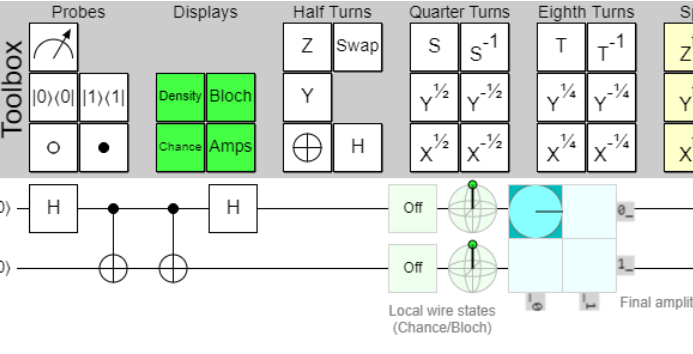
In our repository, two qubits undergo the same kind of repeated X, Z, and ZZ operations. We can therefore track the Floquet unitary, measurement probabilities, magnetization, and entanglement exactly. We observe clear oscillations. But two qubits have no thermodynamic limit, no spatial operator growth across a large lattice, and no robust many-body phase.
The toy model therefore does not prove prethermal order. It teaches us which mathematical building blocks, observables, and verification steps are needed later. In part 2, we build the full Floquet-Ising cycle and show why the heavy-hex lattice is divided into three bond layers.