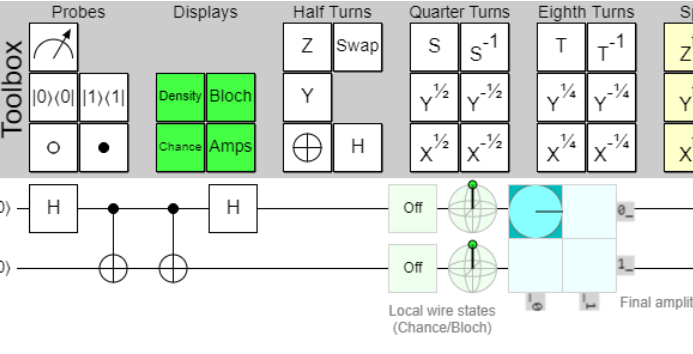

Part 4 · compact hardware gate
Twelve fermionic spinor modes would normally require twelve qubits. With eleven electrons, however, there is exactly one hole. The physical space therefore contains only twelve basis states and fits exactly into four qubits.
The exact reduction
The dimension is C(12,11)=12. Four qubits provide sixteen computational basis states; twelve encode the one-hole states and four are padding. For the frozen, non-interacting Γ-point Hamiltonian, this compression removes no state from the chosen sector.
Because the initial state is known, we prepare it directly and perform real-time evolution. There is no parameterised ansatz and no optimiser—therefore no VQE landscape, barren plateau or repeated energy-minimisation loop.
IBM Kingston
Job d9r0lopdsedc73ag0f1g ran with 4096 shots on ibm_kingston. The raw result had a Hellinger fidelity of 0.762867 and a total-variation distance of 0.271808 relative to the exact distribution. Exact postselection onto the twelve valid codes raised the fidelity to 0.849566. M3 readout correction combined with the same postselection reached 0.858053.
| Analysis route | Hellinger fidelity | TV distance |
|---|---|---|
| Raw | 0.762867 | 0.271808 |
| Raw + exact sector postselection | 0.849566 | 0.197817 |
| M3 + exact sector postselection | 0.858053 | 0.188384 |
What mitigation means here
Postselection uses an exact symmetry: four of the sixteen strings cannot belong to the compact one-hole space. M3 corrects readout errors. Additional runs with dynamical decoupling and gate twirling are useful diagnostics, but a single time-ordered sequence on a drifting backend is not a clean causal experiment.
Sources and reproducibility
Project status: 13 August 2026. Numerical values come from the frozen local research artifacts; the original claim boundaries are deliberately preserved.