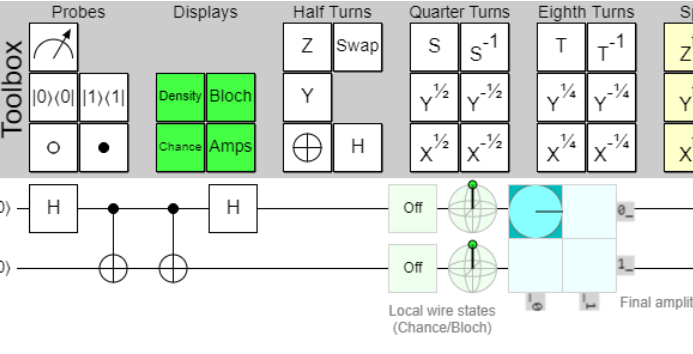

The observable-compressed circuit was shallow enough to make a narrow hardware question meaningful: does the fixed-input braid-order probability agree with its Fibonacci target when measured alongside state-assignment controls and repeated before and after a reference circuit?
The diagnostic job d9veubgb1g9c73a8hlp0 completed on ibm_marrakesh. It contained seven circuits, each with 256 shots. No two-qubit gates and no Fire Opal execution were used.
This is a diagnostic of one digitally encoded fusion-space observable. It is not a hardware execution of every F-move in the nine-qubit source diagram.
Why the circuits were interleaved
A single target circuit can look convincing for the wrong reason. Readout assignment may be biased, calibration can drift, and one anomalous batch can dominate a small sample. The protocol therefore interleaved:
- q2 prepared in \(|0\rangle\) before and after the target block;
- q2 prepared in \(|1\rangle\) before and after the target block;
- the nontrivial order-21 circuit before and after a reference;
- the order-12 reference, whose ideal \(P(q_2=0)\) is one.
The remaining eight qubits served as the same fixed-basis guard used in the readiness simulation. Leakage was evaluated from their measured bit patterns, rather than inferred from the logical qubit alone.
Direct measurements
| Circuit | \(P(q_2=0)\) | 95% interval | Fusion-space leakage | |
|---|---|---|---|---|
| control $ | 0\rangle$ pre | 1.0000 | \([0.9852,1.0000]\) | 3.52% |
| control $ | 1\rangle$ pre | 0.0039 | \([0.0007,0.0218]\) | 3.52% |
| order 21 pre | 0.3711 | \([0.3142,0.4318]\) | 5.47% | |
| order 12 reference | 1.0000 | \([0.9852,1.0000]\) | 5.47% | |
| order 21 post | 0.4219 | \([0.3630,0.4831]\) | 3.52% | |
| control $ | 0\rangle$ post | 1.0000 | \([0.9852,1.0000]\) | 5.08% |
| control $ | 1\rangle$ post | 0.0117 | \([0.0040,0.0339]\) | 4.30% |
All expected shots returned, the native mappings and observables matched the frozen protocol, and transpilation introduced no two-qubit gates.
Assignment correction and the golden-ratio target
Pooling the \(|0\rangle\) and \(|1\rangle\) controls gave a q2 assignment visibility of \(0.992188\). The raw pooled order-21 probability was \(0.396484\). Applying the preregistered one-qubit assignment correction produced
\[P_0^{\mathrm{corr}} = 0.391732,
\qquad 95\%\ \mathrm{CI}=[0.348972,0.435287].
\]
The ideal Fibonacci value \(1/\phi^2=0.381966\) lies inside that interval. The maximum observed encoded-subspace leakage was 5.47%, below the frozen 10% limit.
Drift and the earlier smoke result
The two new order-21 repetitions differed by \(-0.0508\), with an interval that included zero. The q2 assignment controls also showed no significant pre/post drift. An earlier low-shot smoke result was lower than the new pooled measurement, and that difference did exclude zero. Because the new repetitions agree with each other while the assignment error is small, the earlier deviation did not reproduce and is not used as the final estimate.
This is precisely why the control structure matters. Without it, one could have selected whichever small run happened to sit closest to the ideal value.
Decision: proceed, but only one step
All preregistered diagnostic checks passed, so the recorded outcome is GO TO FULL PROTOCOL. That means the higher-shot version of the same compressed observable is scientifically authorized as the next experiment. It does not mean that the full protocol has already run, and it does not reopen the much deeper source circuit for hardware execution.
The result is encouraging because a real device reproduces the expected fixed-input probability within quantified uncertainty. It is deliberately modest because nine logical source qubits, physical Fibonacci anyons, topological error protection, scaling, and quantum advantage remain outside the demonstrated claim.