
Edukaizen

Menu
  • News
  • Hubbard 1D
    • Part 1: 1D Hubbard model
    • Part 2: Snake layout and fSWAP
    • Part 3: Qiskit and Fire Opal
    • Part 4: 120-qubit run
    • Part 5: Time-to-answer
    • Part 6: Tensor networks
    • Part 7: Majorana propagation
    • Part 8: Reading heatmaps
    • Part 9: Digital vs cold-atom labs
    • Part 10: Official Monoprop benchmark
  • Hubbard 2D
    • Part 1: 1D to 2D
    • Part 2: Cuprates
    • Part 3: 3×3
    • Part 4: Time
    • Part 5: 4×4
    • Part 6: 6×6 Fez
  • Hadron
    • Part 1: Hadron on a quantum processor
    • Part 2: Quarks and confinement
    • Part 3: SU(2) and LSH
    • Part 4: Hamiltonian and circuit
    • Part 5: Fire Opal
    • Part 6: Classical simulations
    • Part 7: Quantum advantage
  • Black Hole OLE
    • Part 1: What we ran
    • Part 2: How OLE works
    • Part 3: Fire Opal and Kingston
    • Part 4: The tensor-network challenge
    • Part 5: Hawking and scrambling
    • Part 6: What the result proves
    • Part 7: Local toy model
    • Part 8: QGSS26 compatibility
  • Random Graph
    • Start here
    • Part 1: Theory
    • Part 2: Circuit
    • Part 3: Qiskit
    • Part 4: Complexity
    • Part 5: Verification
    • Part 6: Workflow
    • Part 7: Conclusion
  • QOS QML
    • Tutorial: UMI counts to a four-qubit circuit
    • Part 1: The QML task
    • Part 2: QOS theory
    • Part 3: Gene expression to 40 qubits
    • Part 4: JAX to hardware
    • Part 5: Readout and classifier
    • Part 6: 40-qubit result
    • Part 7: Route to quantum advantage
    • Part 8: 60-qubit result
  • Floquet-Ising
    • Part 1: Floquet physics
    • Part 2: Ising cycle
    • Part 3: Two-qubit toy model
    • Part 4: Oscillation and entanglement
    • Part 5: Noise and error mitigation
    • Part 6: Toward 51 qubits
  • Quantum Gold
    • Part 1: Why gold is a relativistic quantum problem
    • Part 2: Why the 2025 gold VQE study stalled
    • Part 3: From QE and spin–orbit coupling to Qiskit
    • Part 4: Twelve gold spinor modes on four qubits
    • Part 5: The 24-qubit route: an active window for transport
    • Part 6: 24 qubits on IBM and with Fire Opal
    • Part 7: The road to quantum advantage for gold
    • Part 8: 24 gold spinor modes on IBM with ZNE-PEA
  • Advantage List
Menu

Author: admin

Fermi-Hubbard on a quantum computer, part 7: Majorana propagation as a laptop competitor

Posted on July 2, 2026July 2, 2026 by admin

English | Nederlands | Project page | Previous | Next A good quantum-advantage discussion needs a strong classical competitor. In this series, tensor-network TDVP is the standard competitor, but there is another…

Fermi-Hubbard op 60 qubits, deel 1: van Hamiltoniaan naar snake-layout en fSWAPs

Posted on May 12, 2026May 13, 2026 by admin

Een reproduceerbare, kleinere Fermi-Hubbard run laat zien waarom de Q-CTRL aanpak werkt: niet door een generieke compiler, maar door fysica, fermionische mapping, fSWAPs en een hardwarebewuste snake-layout samen te ontwerpen.

Black-Hole Information, OLE, and an 80-Qubit Echo Signal

Posted on March 22, 2026March 22, 2026 by admin

Stephen Hawking’s black-hole information problem is one of the most famous puzzles in modern physics. If a black hole evaporates, what happens to the information that fell in? The modern answer is…

Explaining the quantum eraser with python

Posted on September 26, 2024September 1, 2025 by admin

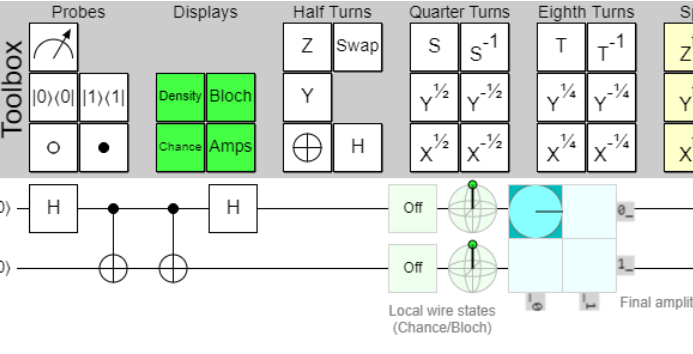
1. Introduction to the Experiment 2. Basic Setup of the Delayed Choice Quantum Eraser Double-Slit Experiment Introducing Entanglement Which-Path Information 3. Common Misconceptions Decoherence Explained Key Clarification 4. Introducing the Quantum Eraser…

How I Saved the planet from global warming (with a quantumcomputer)

Posted on September 26, 2024September 1, 2025 by admin

How it started. ——————————————————————————————————————– “The greatest threat to our planet is the belief that someone else will save it.” — Robert Swan ——————————————————————————————————————– I remember the day vividly. The news was abuzz…

Vibrational Structure Calculation: CO2 Ground state, stretching and bending modes

Posted on September 16, 2024September 1, 2025 by admin

The molecular Hamiltonian, which governs the behavior of molecules, can be simplified using the Born-Oppenheimer approximation. This approximation is crucial because it decouples the movement of nuclei and electrons due to their…

  • Previous
  • 1
  • 2

Recent Posts

  • Quantum computing news — August 13, 2026
  • Quantum computing news — August 12, 2026
  • Quantum computing news — August 11, 2026
  • Quantum computing news — August 10, 2026
  • Quantum computing news — August 9, 2026

Recent Comments

No comments to show.

Archives

  • August 2026
  • July 2026
  • May 2026
  • March 2026
  • February 2026
  • September 2024

Categories

  • 10
  • Quantum Computing
  • Uncategorized
©2026 Edukaizen | Theme by SuperbThemes