Edukaizen

Menu
  • News
  • Hubbard
    • Hubbard 1D
      • Part 1: 1D Hubbard model
      • Part 2: Snake layout and fSWAP
      • Part 3: Qiskit and Fire Opal
      • Part 4: 120-qubit run
      • Part 5: Time-to-answer
      • Part 6: Tensor networks
      • Part 7: Majorana propagation
      • Part 8: Reading heatmaps
      • Part 9: Digital vs cold-atom labs
      • Part 10: Official Monoprop benchmark
    • Hubbard 2D
      • Part 1: 1D to 2D
      • Part 2: Cuprates
      • Part 3: 3×3
      • Part 4: Time
      • Part 5: 4×4
      • Part 6: 6×6 Fez
    • 2D Local Quantum Advantage
      • Deel 1: Doel en budget
      • Deel 2: Fermionmodel
      • Deel 3: Mapping en diepte
      • Deel 4: Pilots en shots
      • Deel 5: Foutmitigatie
      • Deel 6: 6×6-resultaten
      • Deel 7: Circa 20x
      • Deel 8: Google en Bonsai
      • Deel 9: Volgende stap
  • Hadron
    • Part 1: Hadron on a quantum processor
    • Part 2: Quarks and confinement
    • Part 3: SU(2) and LSH
    • Part 4: Hamiltonian and circuit
    • Part 5: Fire Opal
    • Part 6: Classical simulations
    • Part 7: Quantum advantage
  • Black Hole OLE
    • Part 1: What we ran
    • Part 2: How OLE works
    • Part 3: Fire Opal and Kingston
    • Part 4: The tensor-network challenge
    • Part 5: Hawking and scrambling
    • Part 6: What the result proves
    • Part 7: Local toy model
    • Part 8: QGSS26 compatibility
  • Random Graph
    • Start here
    • Part 1: Theory
    • Part 2: Circuit
    • Part 3: Qiskit
    • Part 4: Complexity
    • Part 5: Verification
    • Part 6: Workflow
    • Part 7: Conclusion
  • Floquet-Ising
    • Part 1: Floquet physics
    • Part 2: Ising cycle
    • Part 3: Two-qubit toy model
    • Part 4: Oscillation and entanglement
    • Part 5: Noise and error mitigation
    • Part 6: Toward 51 qubits
  • XXZham
    • Part 1: The XXZ model and imbalance
    • Part 2: From dynamics to a quantum circuit
    • Part 3: The classical simulation methods
    • Part 4: Error mitigation on real hardware
    • Part 5: Results and the classical comparison
    • Part 6: Original study and next steps
  • Work
    • QOS QML
      • Tutorial: UMI counts to a four-qubit circuit
      • Part 1: The QML task
      • Part 2: QOS theory
      • Part 3: Gene expression to 40 qubits
      • Part 4: JAX to hardware
      • Part 5: Readout and classifier
      • Part 6: 40-qubit result
      • Part 7: Route to quantum advantage
      • Part 8: 60-qubit result
    • Quantum Gold
      • Part 1: Why gold is a relativistic quantum problem
      • Part 2: Why the 2025 gold VQE study stalled
      • Part 3: From QE and spin–orbit coupling to Qiskit
      • Part 4: Twelve gold spinor modes on four qubits
      • Part 5: The 24-qubit route: an active window for transport
      • Part 6: 24 qubits on IBM and with Fire Opal
      • Part 7: The road to quantum advantage for gold
      • Part 8: 24 gold spinor modes on IBM with ZNE-PEA
      • Part 9: Forced gold colour on 56 qubits
    • HaPPY Gravity
      • Part 1: Gravity as a phase gate
      • Part 2: Bosons and convergence
      • Part 3: The dynamic HaPPY benchmark
      • Part 4: The N=145 classical audit
      • Part 5: MPS and Majorana baselines
      • Part 6: PEA/ZNE and the decisive test
    • Fibonacci Anyons
      • Part 1: Fusion and braiding
      • Part 2: The 3/5/9-qubit ladder
      • Part 3: Why nine qubits were too deep
      • Part 4: Structure-aware simplification
      • Part 5: IBM hardware diagnostic
      • Part 6: Results and open questions
  • Advantage List
  • Contact
Menu

Qiskit Circuit Lab

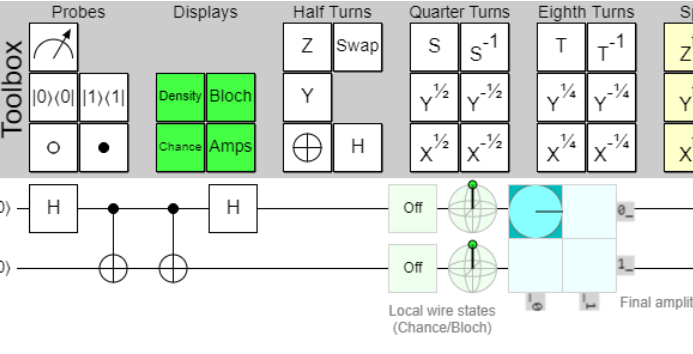
Bouw een klein quantumcircuit, simuleer de meetkansen lokaal en exporteer direct uitvoerbare Qiskit-code. Een browseragent kan dezelfde zichtbare acties via WebMCP uitvoeren.

Dit is een educatieve, veilige eerste versie. De simulatie blijft in de browser, is begrensd tot vier qubits en start geen IBM Quantum-job. Er is geen account of API-token nodig.

Open het Qiskit Circuit Lab in volledig scherm

Wat kun je proberen?

  • maak een quantum-munt met een Hadamardpoort;
  • bouw een Bell-paar of een GHZ-toestand;
  • bekijk hoe fase door interferentie zichtbaar wordt;
  • kopieer het circuit als Python-code voor Qiskit Aer.

Experimenteel: WebMCP is nog een browserstandaard in ontwikkeling. In browsers zonder native WebMCP blijft het volledige circuitlab gewoon handmatig bruikbaar.

Recent Posts

  • Quantum computing-nieuws — 18 september 2026
  • A Call to Qiskit Advocates: Help Test Quantum Advantage
  • Quantum computing-nieuws — 11 september 2026
  • Quantum computing-nieuws — 4 september 2026
  • Quantum computing-nieuws — 28 augustus 2026

Recent Comments

  1. XXZham: simulating 80 spins with a NISQ quantum computer - Edukaizen on XXZham: quantumsimulatie van 80 spins

Archives

  • September 2026
  • August 2026
  • July 2026
  • May 2026
  • March 2026
  • February 2026
  • September 2024

Categories

  • 10
  • Quantum Computing
  • Uncategorized
©2026 Edukaizen | Theme by SuperbThemes